
eCheck Casinos Canada
I treat eCheck casinos in Canada as a banking niche, not a payment shortcut. The appeal is simple enough: you fund a casino account from a bank account without entering card details, and in some cases you can cash out back through a similar bank-linked route. The catch is that eCheck support is not as common or as predictable as Interac. Some casino cashier pages use “eCheck”, some use “eCheque”, some describe the same idea as EFT or bank transfer, and some remove the option without much warning.
That is why I look at eCheck from the player side first. Can you deposit in CAD? Does the casino clearly say whether eCheck works for withdrawals? Are there minimums, pending periods, bank-side fees, or verification steps before the first cashout? If those answers are buried, I would slow down before depositing.

For a narrower deposit walkthrough, use the eCheck deposit casino guide. If your main concern is getting winnings out, start with eCheck casino withdrawals. If you are comparing bank rails, the most useful next read is eCheck vs Interac for casino payments.
Quick view of eCheck casino banking in Canada
| Point to check | What I would look for before depositing |
|---|---|
| Deposit support | eCheck, eCheque, EFT, bank transfer, or direct bank account wording in the cashier |
| Withdrawal support | Separate confirmation that cashouts can return by eCheck or bank transfer |
| Currency | CAD account balance or clear foreign exchange notes |
| Timing | Business-day language, not “instant payout” promises |
| Fees | Casino fee, processor fee, and possible bank returned-payment fee |
| Verification | KYC, bank account ownership check, and possible micro-deposit confirmation |
| Bonus eligibility | Whether eCheck deposits qualify for the chosen casino bonus |
| Backup option | Interac, iDebit, Instadebit, card, e-wallet, or other Canadian-friendly method |
The big practical point is that “accepts eCheck” can mean different things. A casino might allow eCheck deposits but push withdrawals through bank transfer, card reversal, Interac, or another route. Another casino might show eCheck only after registration, province selection, or successful identity checks. I would not assume the payment tile will appear for every Canadian player.
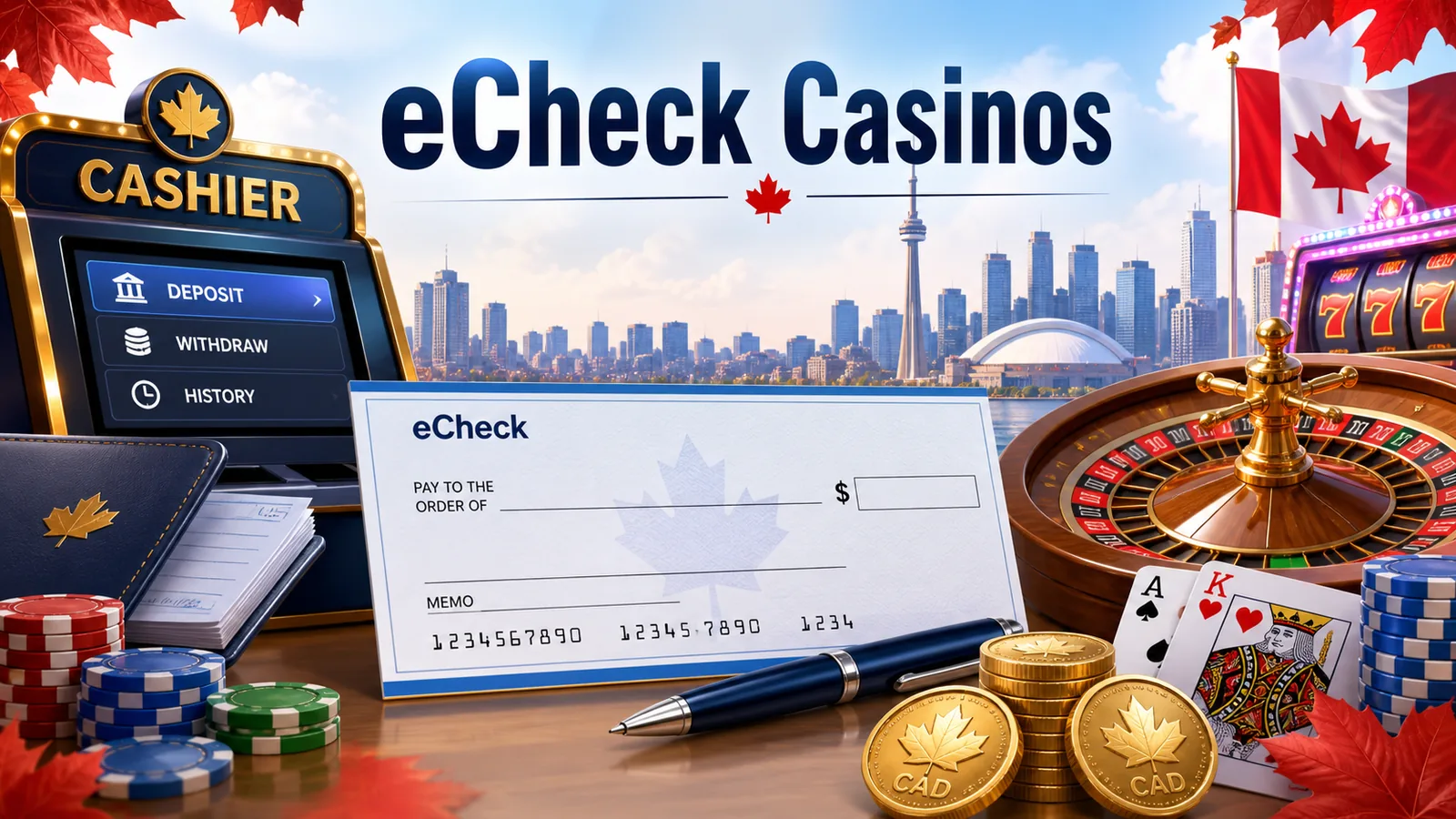
What an eCheck casino actually is
An eCheck casino is an online casino where the cashier supports an electronic cheque-style bank transaction. In plain Canadian terms, it is a direct bank-account payment. Instead of using a credit card number, you authorize a payment from your bank account. Depending on the provider and casino, the transaction may be described as eCheck, eCheque, EFT, AFT, direct bank transfer, or bank account deposit.
I would not get stuck on the spelling. The more important detail is the flow. A proper bank-linked method should tell you what information is needed, whether the funds are deposited in Canadian dollars, whether the casino stores bank details, how long approval takes, and what happens if the bank rejects the request.
The real player concerns are consistent: safety, deposit speed, withdrawal speed, minimum deposits, fees, and whether eCheck remains available at Canadian-facing casinos. Those are the right questions. A banking method is only useful if it works cleanly at the casino you are actually using.
How I would choose an eCheck casino
I would start in the cashier and terms pages before looking at the bonus. That sounds backwards, but it saves hassle. A large bonus is not worth much if the deposit method does not qualify, the withdrawal method is unavailable, or the minimum cashout is higher than expected.
For Canada, I would check these items in order:
1. The casino supports CAD or clearly explains exchange handling. 2. The payment page lists eCheck, eCheque, EFT, or bank transfer in the deposit section. 3. The withdrawal section separately confirms the available cashout routes. 4. The minimum deposit fits your budget. 5. The bonus terms do not exclude bank transfer or eCheck deposits. 6. The KYC page explains what documents may be requested before withdrawal. 7. The help centre gives a realistic business-day timeline. 8. Support can answer payment questions without vague copy-paste replies.
I would also check whether the casino is serving Ontario players under Ontario rules or serving broader Canada from an offshore framework. That does not make one cashier better by itself, but it changes what you should verify. Ontario players should be especially careful to confirm the operator and payment method are available in Ontario before opening an account.
Deposits: where eCheck feels useful
The deposit use case is the cleanest. You log in, open the cashier, choose eCheck or the bank-linked option, enter the amount, confirm the bank details or bank login flow requested by the provider, and wait for approval. Some casinos may credit play balance quickly after approval, while others wait for banking settlement. I would treat any timing claim as casino-specific until the cashier confirms it.
The reason some Canadian players like eCheck is that it keeps the transaction tied to a bank account. That can be useful for budget control because the money has to exist in the account. It can also avoid card-decline friction that sometimes happens with gambling transactions. The tradeoff is that eCheck is less universal than Interac and can be slower than modern instant-bank options.
If you mainly want a first-deposit route, use the eCheck casino deposit walkthrough. If your bankroll is small, compare that with the low deposit eCheck casino notes before choosing a minimum.
Withdrawals: the part to verify twice
Withdrawals deserve more caution than deposits because approval time, pending time, banking settlement, weekend delays, and KYC can all be separate steps. A casino might approve a withdrawal internally, then the bank transfer still takes additional business days.
Before I would rely on eCheck for a cashout, I would check the withdrawal page for exact wording. If it says “bank transfer” rather than eCheck, that may still be a workable route, but it is not the same as confirming eCheck withdrawals. If the casino says withdrawals must go back to the original deposit method where possible, that also matters. A first deposit by eCheck can sometimes affect the available cashout route.
KYC is normal in this area. Casinos may request proof of identity, proof of address, and proof that the bank account belongs to you. If the payment provider uses micro-deposits, you may need to confirm tiny test amounts before the first withdrawal. It is a bit of admin, but it is better to discover it before a large cashout is pending.
eCheck vs Interac in Canada
Interac is the benchmark for many Canadian players because it is familiar, bank-linked, and widely recognized. eCheck can still be useful, but I would compare the two based on availability, speed, and how much banking detail you share.
| Situation | eCheck may suit you | Interac may suit you |
|---|---|---|
| You want direct bank-account funding | Yes, if the casino supports it | Yes, usually through Interac e-Transfer or similar flow |
| You want the most common Canadian option | Sometimes | Usually stronger |
| You want quick deposits | Sometimes after approval | Often quicker, but verify by casino |
| You want faster cashouts | Not usually the first choice | Often better, though still casino-specific |
| You dislike card deposits | Useful alternative | Useful alternative |
| You need broad casino availability | Limited | Generally broader |
My short version: if both are available and the terms are equal, Interac is often easier for Canadian players. If eCheck has better limits, bonus eligibility, or bank-account control at a specific casino, it can still make sense.
Bonus and no-deposit rules
Do not assume an eCheck deposit automatically qualifies for a welcome bonus. Many casino bonuses accept ordinary cash deposits, but some payment methods are excluded, and the exclusion list can change. I would check the bonus terms for payment restrictions before sending money.
No-deposit bonuses are different. If a casino gives free spins or bonus credit without a deposit, the payment method may not matter at claim time. It can matter later when you need to verify the account, make a qualifying deposit, or withdraw winnings. For that reason, no-deposit players should still read the banking page early. The detailed version is in the eCheck no-deposit and payment rules guide.
Safety and responsible play
eCheck can be a sensible payment method, but the casino matters more than the rail. I would avoid any site that hides its payment terms, pushes unrealistic cashout promises, or has support agents who cannot explain withdrawal rules. A legitimate-looking cashier does not replace responsible checks.
For Canadian players, responsible gambling tools should be easy to find: deposit limits, cool-off periods, self-exclusion options, and reality checks. Age rules also vary by province, with 19+ common in most provinces and 18+ in Alberta, Manitoba, and Quebec. Check your local rules and the casino’s terms before playing.
FAQ
Do online casinos in Canada still accept eCheck?
Some Canadian-facing casinos describe eCheck, eCheque, EFT, or bank-transfer options, but availability can be inconsistent. I would verify inside the cashier and terms before relying on it.
Are eCheck casino deposits instant?
Not always. Some casinos may credit funds quickly after approval, but eCheck and EFT-style payments can involve bank processing. Treat “instant” as a claim to verify at the specific casino.
Can I withdraw with eCheck?
Sometimes, but do not assume it. Check whether the withdrawal page specifically lists eCheck, bank transfer, or another route, and confirm KYC requirements before cashing out.
Is eCheck better than Interac?
Usually not for broad Canadian availability. eCheck can suit players who prefer a direct bank-account method, while Interac is often easier to find and may be quicker at many casinos.
Can I use eCheck in CAD?
Many Canadian-facing casino pages discuss CAD banking, but the account currency still needs to be confirmed at the casino. Avoid depositing until you know whether conversion fees apply.